
Criminal Cases in the Gordon County Courts
Gordon County Superior Court has exclusive felony jurisdiction. Its clerk files criminal cases and maintains criminal warrants. Gordon County State Court handles misdemeanors and traffic within its authority. Magistrate Court issues warrants and conducts preliminary or first-appearance functions. Calhoun and other municipal courts keep ordinance and qualifying traffic matters within their own dockets.
Venue determines where the court case record lives. A city bench warrant may never appear in a Superior Court-only search. Likewise, an arrest at the Gordon County Justice Center does not prove that a prosecutor filed the intake charge. Start with the court shown on the citation, warrant, accusation, indictment, or hearing notice. The Gordon Clerk of Superior Court is the official source for felony case files and filed criminal warrants.
Which Gordon Court Has the Case?
Georgia does not use one county court for every criminal matter. A felony belongs in Superior Court. Most county misdemeanors go to State Court, while Magistrate Court handles warrants and early proceedings rather than a full felony trial. Municipal courts retain city ordinance and authorized traffic matters. This division is why a name can produce no result in one system yet still have a public case in another.
| Record question | Gordon venue | Best proof |
|---|---|---|
| Felony charge and outcome | Superior Court | Indictment or accusation, judgment, and sentence |
| County misdemeanor | State Court | Filed accusation and disposition |
| Warrant or first appearance | Magistrate or issuing court | Warrant status and related order |
| City ordinance or traffic case | Issuing municipal court | Municipal docket and final disposition |
Check the case number and court name before reading the result. Similar numbers across venues do not mean the records describe the same Gordon County criminal case.
Classification can also point toward venue. Georgia calls an offense a felony when its authorized punishment can exceed twelve months, while a misdemeanor is generally punishable by no more than twelve months. A high and aggravated misdemeanor remains a misdemeanor despite its higher possible fine. Confirm classification from the filed charge, not the booking label.
How to Search Case Records
The Georgia judicial e-access gateway routes readers to participating providers and warns that account or provider rules can vary. Gordon’s trial-information page offers calendars and public court material, but it is not a complete name index. Exact case numbers work best. For a name search, add the correct court, a filing range, and other lawful identifiers to avoid a false match.
- Identify the venue from the citation, warrant, hearing notice, or charging paper.
- Choose Gordon County and the correct court through the available provider.
- Search the exact case number, or use name plus filing range and case category.
- Open the docket and read every count, event, plea, and disposition.
- Request the judgment, sentence, and accusation or indictment from the clerk when official proof is needed.
| Field Label | Type | Required | Notes |
|---|---|---|---|
| Court / County | Dropdown | Yes | Select Gordon and the venue that handled the case |
| Party Last / First Name | Text | One search route | Spelling and similar names require care |
| Case Number | Text | No | Strongest exact key when known |
| Filing-Date Range | Date controls | No | Narrows common names and older results |
| Case Category / Status | Dropdown | No | Filters the result set by type or posture |
If a provider requires registration or fails to display a document image, use the clerk’s request channels. A portal result is an index aid. It does not guarantee that every paper, sealed item, or older archived file is online.
Gordon Criminal Case Copies
The Gordon Clerk publishes mail, fax, and staff-directory email routes for copy requests. Call the public-record line at 706-629-2139 before relying on fax or planning a counter visit. Name the court, case number, document, and whether certification is necessary. “All records” can cause delay when a judgment and accusation would answer the question.
Published clerk charges distinguish 50 cents per page for unassisted copies, $1 per page for assisted copies, and $2.50 for a certification stamp. The official Clerk services and fees page is the source for those amounts and request channels.
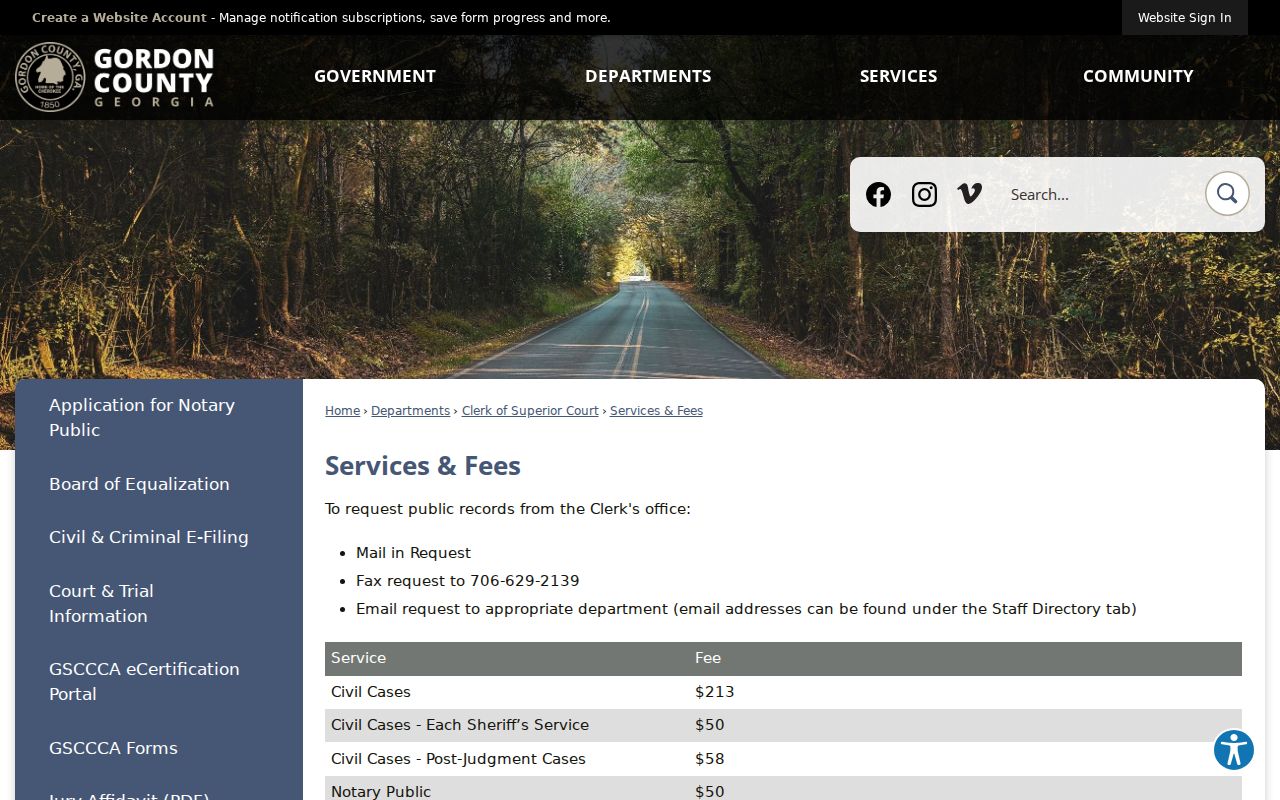
The fee distinctions make a targeted request cheaper and clearer. Ask for an estimate when staff must locate or reproduce a larger Gordon County criminal file.
What the Case File Shows
A criminal case file documents prosecution after filing. The docket is a dated list of events, not the full evidence or a one-line verdict. Read charge-level entries because one count may end in a plea while another is dismissed or placed on the dead docket. “Disposed” means the court entered an outcome. It does not always mean conviction.
| Case Number & Court | Venue and unique file identifier |
|---|---|
| Charging Document | Accusation or indictment stating the charge selected for prosecution |
| Docket Entries | Dated filings, hearings, motions, warrants, and orders |
| Hearing Dates | Calendar date, time, court, and courtroom when public |
| Disposition & Judgment | Plea, verdict, dismissal, nolle prosequi, or other result for each count |
| Sentence & Conditions | Custody, probation, fines, costs, restitution, and court-ordered terms |
Protected identifiers, victim and minor details, sealed documents, and full dates of birth should not appear in the ordinary public view. Request a certified disposition when an exact, authenticated outcome matters.
Financial entries need the same care as charge entries. A displayed balance may combine fines, statutory surcharges, restitution, and court costs. The docket may not itemize every part. A certified copy authenticates the clerk’s document, but it does not turn an allegation in a charging paper into a proven fact.
Read Every Gordon Criminal Count
Do not stop at the overall status line. Open each count and compare the charge first filed with the final disposition. A nolle prosequi means the prosecutor ended that charge. A dead docket is inactive but is not the same as a final dismissal. A no bill means the grand jury declined to indict. These terms describe different procedural results.
- Accusation
- A prosecutor’s formal charging document.
- Indictment
- A grand jury’s true bill that states felony charges.
- Nolle prosequi
- A prosecutor’s formal decision to end a charge.
- Disposition
- The final recorded status of an individual count.
First Offender treatment also requires care. Successful statutory discharge has a distinct effect and should not be casually labeled a conviction. Read the sentence and later discharge documents together.
Stages of a Criminal Case
A police booking charge can change before the court file begins. The Cherokee Judicial Circuit District Attorney selects and prosecutes Superior Court charges in Gordon and Bartow Counties. The official Cherokee Circuit DA site provides current office and program details. The public defender represents qualifying indigent defendants but is not the custodian of public files.
Case flow: Charges Filed › Arraignment › Pretrial › Plea or Trial › Disposition › Sentencing
Arraignment is the formal plea stage. Pretrial entries may include motions, discovery issues, bond rulings, and calendar settings. A plea or verdict does not finish the record by itself; the judgment and sentence state the court’s final action and terms.
Probation is a court disposition even when no prison term is imposed. Parole is different because it follows release authority connected to a prison sentence. Read the judgment for probation, then use state correctional sources only when the file shows a transfer or prison sentence.
Gordon Criminal Court Calendars
The official Gordon trial-information page says most court sessions begin at 9:00 a.m. unless otherwise noted. A calendar is useful for confirming a listed session, but it is not a complete case-name database and does not replace the docket. Standing orders and schedule changes should be checked before a courthouse trip.
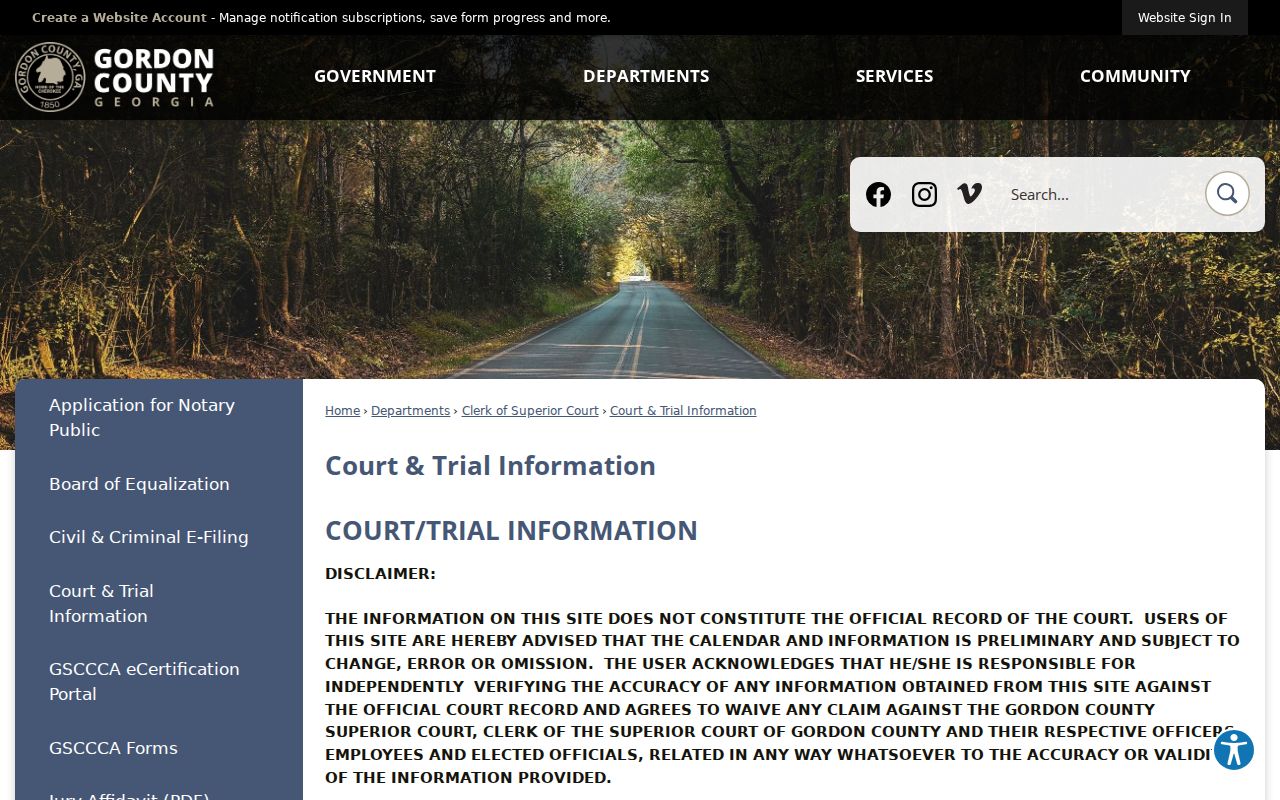
The calendar view supplies timing context. The clerk’s criminal file remains the source for pleadings, count-level outcomes, and certified court records.
Note: A hearing date can change, so confirm the current Gordon County criminal calendar before traveling or relying on an older docket entry.
Warrants in Gordon Court Records
The Superior Court clerk files criminal warrants, but no complete public active-warrant portal was verified. Check the issuing venue. Magistrate Court may issue an arrest warrant, a municipal court may issue a bench warrant, and a warrant can appear as an event inside an existing case rather than a new prosecution. Sealed or unexecuted material may not be public.
For one’s own warrant question, contact the issuing court or counsel and ask for the warrant number, related case, current status, and any recall or execution date. A blank ordinary name search is not clearance. Keep any recall order or receipt and confirm the update with both the court and the executing agency.
A bench warrant often follows a missed appearance or another unmet court directive. An arrest warrant rests on a judicial probable-cause finding. A capias is a writ directing custody. The docket context and issuing order show which term applies, so avoid treating all warrant entries as new criminal charges.
Access & Restrictions
Georgia court records are generally open, but public access can include redactions and limits. Juvenile material, protected victim information, personal identifiers, sealed warrants, and sealed court records may be withheld. The Georgia Open Records Act resources explain public-agency access, while judicial files should be requested from the actual court clerk rather than the county administrative custodian.
Access rule: O.C.G.A. §§ 50-18-70 through 76 establish open-record procedures subject to exemptions. O.C.G.A. § 35-3-37 governs record restriction and related court-record sealing.
If a public result lacks a disposition, obtain the judgment from the Gordon clerk and ask the court or prosecutor to transmit the source correction. GCIC cannot correct missing court data without authorized documentation. Record restriction and judicial sealing are related but distinct, so verify both the state history and public court view after any approved action.