
Running a Sex Offender Check in Gordon County
The Georgia Sex Offender Registry search is the main public channel for Gordon County. The Georgia Bureau of Investigation manages the statewide system, while sheriffs, the Georgia Department of Corrections, and the State Board of Pardons and Paroles supply or update parts of the record. Start with the county filter for Gordon-wide awareness. Use a name only when there are enough identity details to distinguish the correct person.
Geographic tools can narrow a check to Calhoun, Resaca, Fairmount, a ZIP code, or an address radius. Postal labels and city limits do not always match, so a city-only result can omit an address that still lies in Gordon County. Search the county as a second pass. For questions about a Gordon address or local compliance, contact the Gordon County Sheriff rather than drawing a conclusion from an empty or old result.
Gordon County Registry Data Sources
Georgia registry entries follow a multi-agency path. GDC and the Parole Board enter many initial records for people moving through prison or supervision. GBI enters qualifying people who relocate from another jurisdiction. Gordon County’s sheriff receives registration information and updates local changes supplied by registrants.
The GBI registry program page describes that statewide role and warns that source information can change.
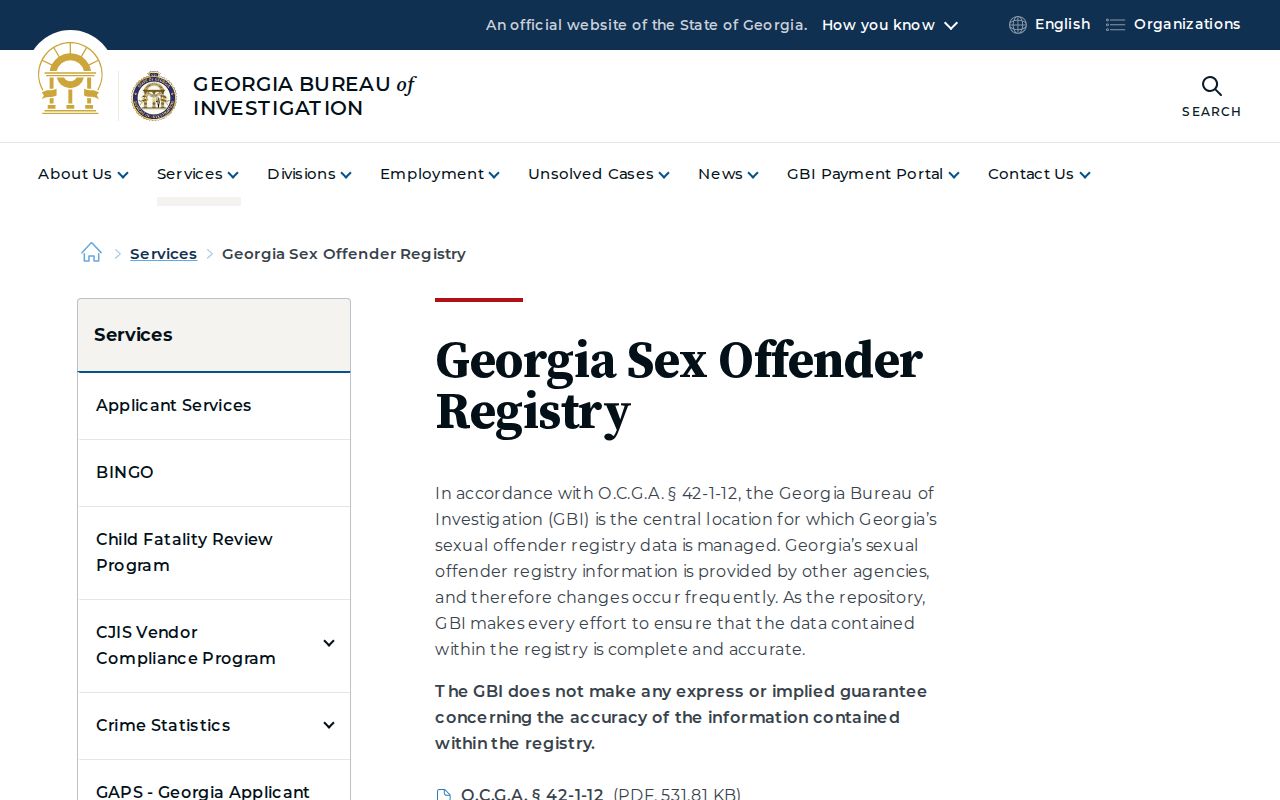
This chain explains why the portal, the sheriff, and a court file can show different kinds of facts. The registry is a public safety record. It is not a full criminal-history report or a substitute for the judgment in the underlying case.
Searching the Georgia Sex Offender Registry
The GBI interface supports both identity and location searches. Spelling matters in a name search, while address and radius searches depend on geocoding. Use more than one route when the first result is uncertain.
- Open the official Georgia registry and review its conditions and accuracy notice.
- Enter a name, or choose Gordon County and add a city, ZIP, street, or radius when useful.
- Compare aliases, photograph, age, and physical details before selecting a profile.
- Open the full profile and note the registering agency, status, address, and offense source.
| Field Label | Type | Required | Notes |
|---|---|---|---|
| First Name / Last Name | Text | No single field required | Spelling and aliases can change results |
| Offender Type / Status | Dropdown or filter | No | Live options can vary |
| County | Dropdown | No | Choose Gordon for county-wide results |
| City / ZIP Code | Text or dropdown | No | Postal geography may differ from city limits |
| Street / Address | Text | No | Used for the proximity route when enabled |
| Radius | Dropdown | No | Use only the mile options shown live |
| Search / Clear | Buttons | Action | Runs or resets the query |
A broad Gordon County search is the best backstop for a city or ZIP query. If a likely result does not appear, try the known alias and remove extra filters. Avoid guessing at identity from a name alone. The profile’s photograph, age, physical description, and conviction jurisdiction provide the safer match points.
Gordon County Registry Updates Daily
GBI says the public registry updates daily. It also says sheriffs are responsible for updating information provided by a registrant within two business days. Those statements describe the system’s workflow, not a guarantee that every real-world move was reported, checked, and mapped at once.
The official Georgia search screen is the place to review the current public entry.
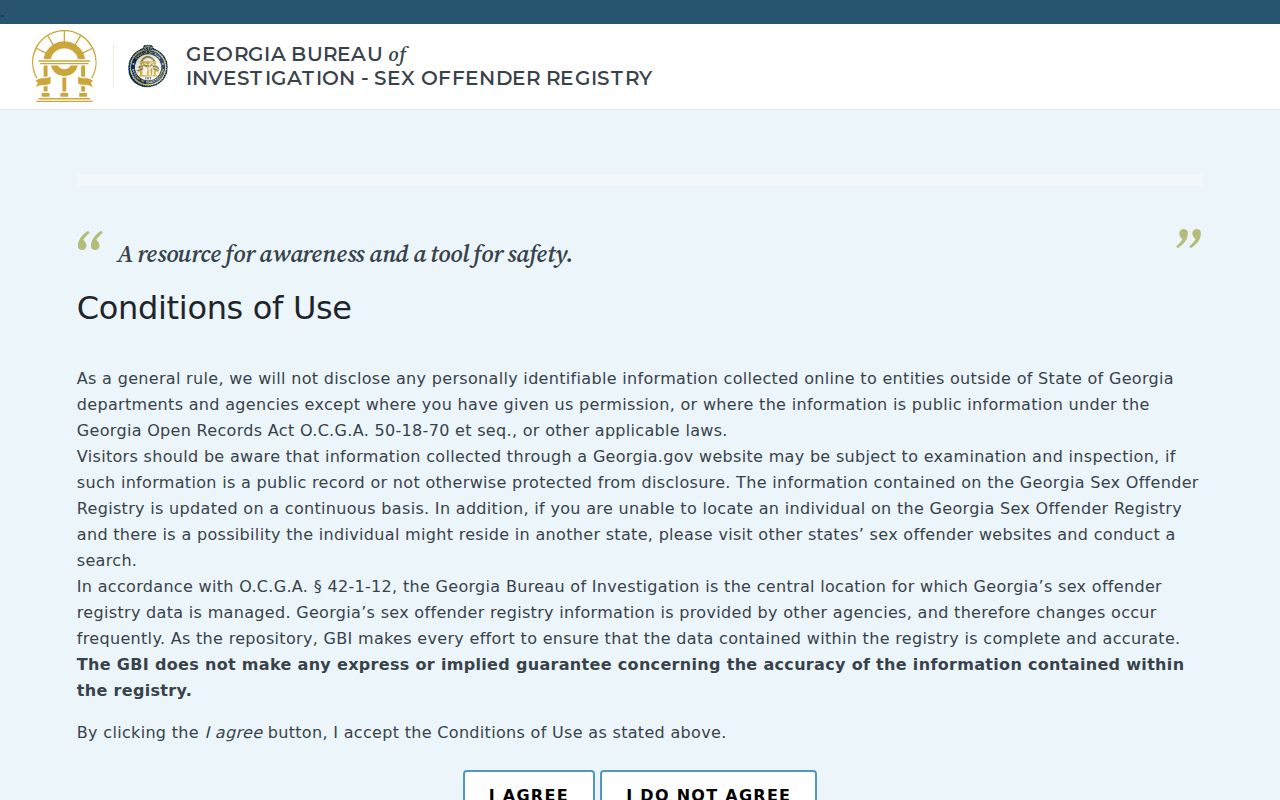
If an address looks wrong, record the profile details and contact the Gordon County Sheriff. Do not visit the address or confront anyone. Agency confirmation is the safe route for a suspected compliance issue.
Note: A daily database refresh does not prove that every change was reported by the person responsible for reporting it.
What a Registry Profile Shows
A public profile joins identity, address, offense, and registration fields. Read them as separate facts. A current photograph and physical description help reduce mistaken identity, but images age and names can be shared. The offense field describes historical legal information. Current compliance status addresses registration duties and does not allege a new sex offense.
| Name & Aliases | Legal name and known alternate names supplied to the system |
|---|---|
| Photo & Physical Description | Current photograph when supplied, sex, race, age or DOB, body descriptors, and marks or tattoos |
| Registered Address | Reported residence and related geographic information, subject to source updates |
| Offense & Statute | Offense description, conviction date, jurisdiction, statute, and possible victim-age category |
| Classification | Georgia statutory status, including sexually dangerous predator when applicable, not a generic federal tier |
| Registration Status | Compliance or registration information and the supervising or registering agency |
| Other Published Fields | Employment, school, or vehicle information when the statute and interface publish it |
These fields support identification and awareness. They should not be copied into sensational lists. When a person believes a listing is wrong, the proper response is a documentary correction through the responsible agency.
Gordon County Registry Across States
Use the national search when a question crosses Georgia’s boundary. The U.S. Department of Justice’s National Sex Offender Public Website searches participating jurisdictions, then routes users back to source registries for detail.
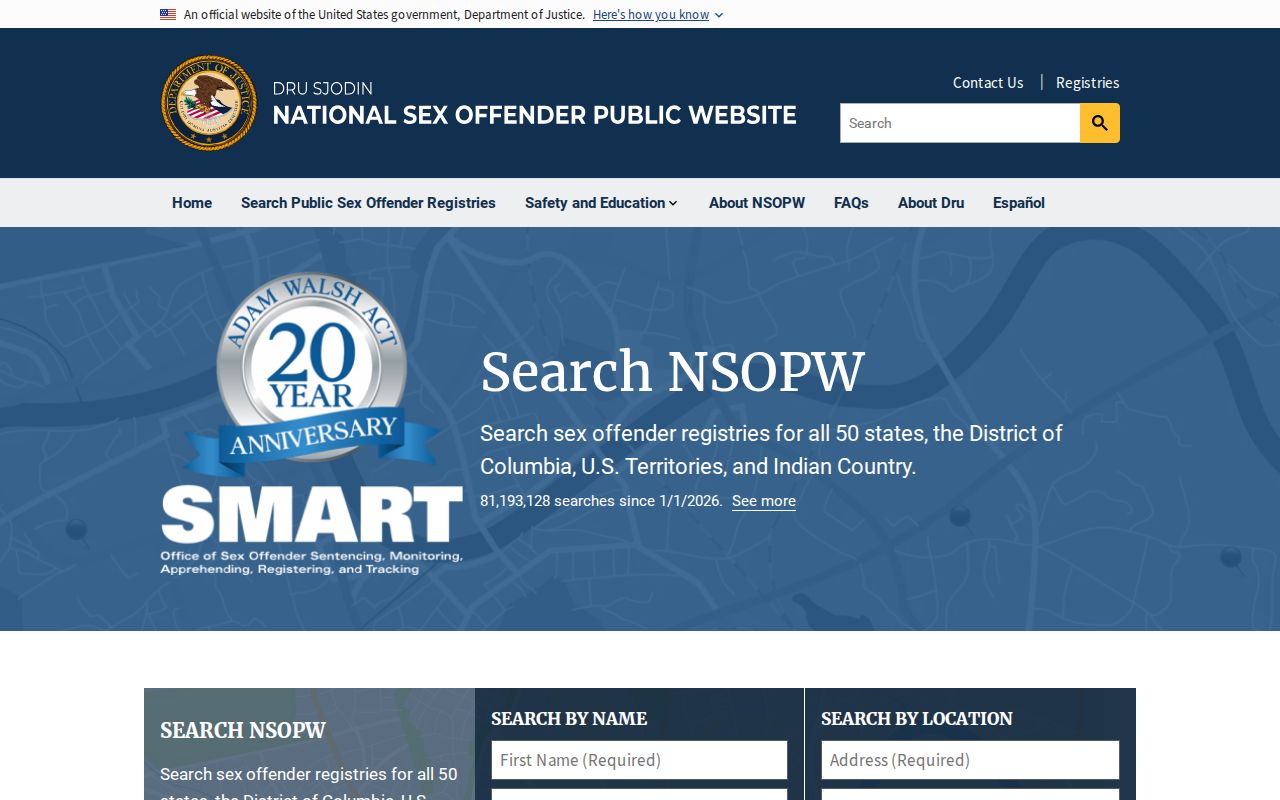
NSOPW broadens geographic coverage, but it does not replace GBI for a Gordon County address. Return to the Georgia profile for state fields and use the sheriff for local compliance questions. Different jurisdictions also publish different information, so a blank field should not be treated as proof that the fact does not exist.
This two-layer method is useful when someone moved into Gordon County from another state or when family safety planning spans more than one jurisdiction. Search nationally for reach, then verify the result with the government registry that created the entry. The source registry controls its own fields, update cycle, and correction route.
Registration Requirements and Levels in Georgia
Georgia does not use a simple public Tier I, II, and III chart with standard federal durations. State duties depend on the qualifying offense, statutory category, sentence or release date, classification, and possible court relief. Many registrants have lifetime duties unless they qualify for release under current law. The statute also distinguishes a sexual offender from a sexually dangerous predator.
| Georgia category or duty | Duration | Reporting rule |
|---|---|---|
| Sexual offender | Often lifetime, subject to the current statute and any judicial release | In-person annual reporting plus prompt reporting of required changes |
| Sexually dangerous predator | Controlled by the current statute and classification | Enhanced statutory requirements apply; confirm the current official text |
| Qualifying out-of-state, federal, military, or tribal case | Depends on Georgia’s registration trigger and current law | Register through the local sheriff within the statutory terms |
| Possible judicial release | Fact-specific and not automatic | Requires the statutory court process; a portal search cannot predict eligibility |
Consult O.C.G.A. §42-1-12 for current duties. Do not import another state’s duration table or assume a federal label controls Georgia consequences.
Gordon County Sheriff Registry Questions
The Gordon County Sheriff is the local registration authority. Call 706-629-1244 to confirm the correct registration contact, appointment process, location, and hours before an in-person visit. The county’s published jail and Justice Center contact is the documented local starting point, but registration arrangements should be confirmed by telephone.
Address changes and suspected noncompliance belong with official staff. Give the profile name, address in question, and the reason for concern without confronting the registrant or household. GBI handles statewide portal and policy questions, while the sheriff handles the local address and compliance role.
Note: The public registry is not a live dispatch system; call emergency services only for an immediate safety threat.
Gordon County Registry Status vs Case
A registry profile and a court docket serve different jobs. The profile displays public registration information tied to a qualifying conviction. The court file holds charging papers, pleas, rulings, judgment, and sentence. “Compliant” means registration duties are shown as current. It does not erase the historical conviction, and “noncompliant” is not itself proof of a new sex offense.
For the legal outcome, locate the correct court and request the judgment or disposition. For the current registration question, use GBI and the Gordon sheriff. Keeping those channels separate prevents a status label from being stretched beyond what it says.
The same distinction applies to dates. A conviction date belongs to the historical case. A verification or update date belongs to the registration process. Neither date, standing alone, proves where a person was on another day. When the exact court result matters, request the filed judgment rather than relying on a brief registry description.
Lawful Use and Community Notification
Registry information supports personal, family, and community safety planning. Check the source entry, account for spelling and geography, and contact officials when a detail needs verification. Never use an address as an invitation to enter property, question occupants, publish accusations, or take enforcement into private hands.
Use registry information lawfully: Georgia’s registry is not permission to harass, threaten, intimidate, trespass, or engage in vigilantism. Report suspected noncompliance to the Gordon County Sheriff and follow O.C.G.A. §42-1-12 and the official registry warning.
The safest action is quiet verification through the agency. Registry data changes, photos age, and address boundaries can be misunderstood. Public safety depends on accurate identification and lawful conduct.